
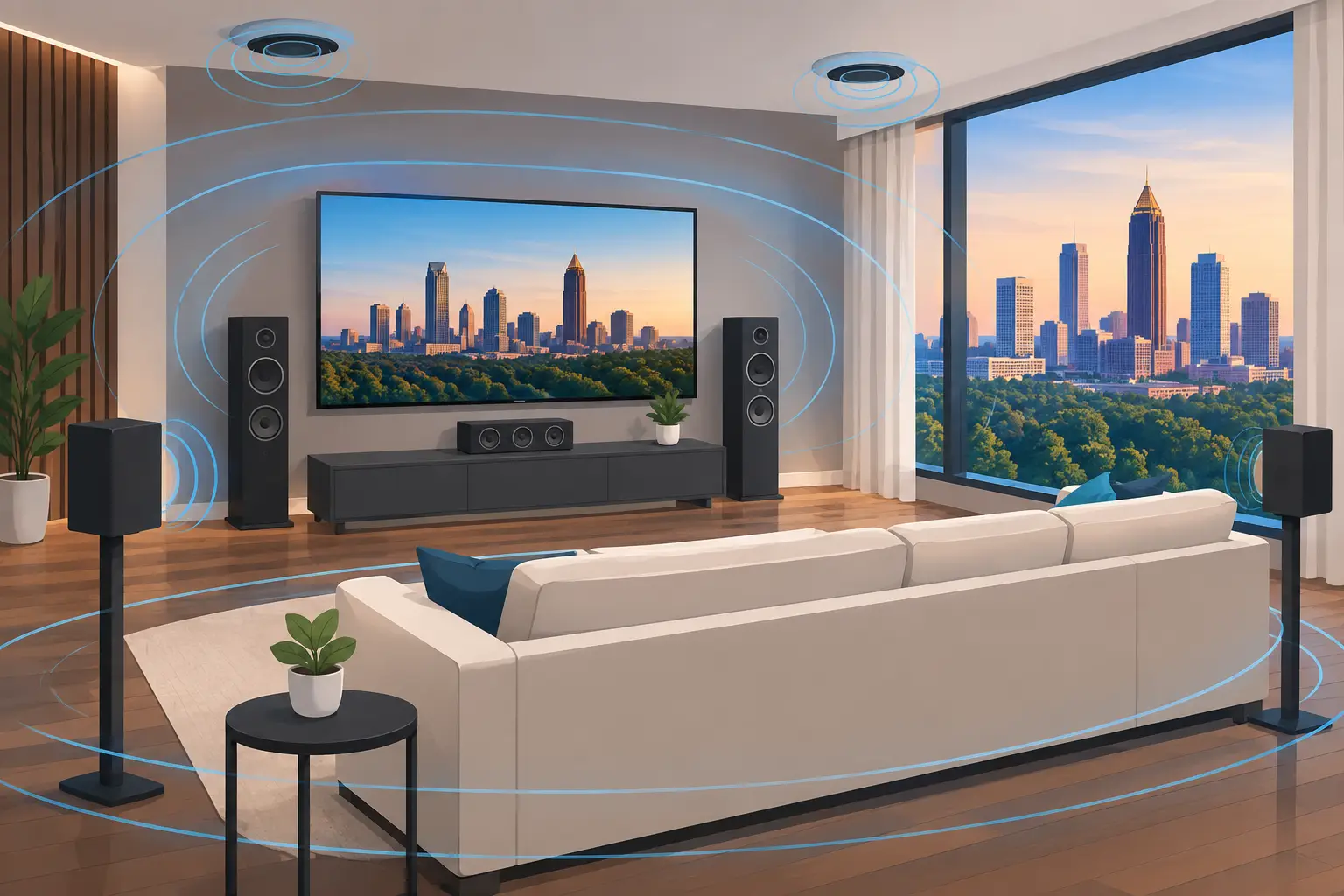
A great picture gets people’s attention. Great surround sound keeps them in the room. When a football crowd fills the space, a movie score moves naturally around the seating area, or a game puts you in the middle of the action, the difference is immediate. But a system with expensive equipment can still disappoint if the room, wiring, speaker placement, and setup are treated as afterthoughts.
For Atlanta homeowners, the right answer is rarely a one-size-fits-all package. A family room with an open kitchen needs a different plan than a dedicated theater, a basement media room, or a condo where neighbors and wall construction affect what is possible. The goal is not simply to add more speakers. It is to build a system that sounds clear, looks finished, and remains easy for everyone in the house to use.
What Surround Sound Actually Does
Surround sound divides a soundtrack into separate channels, allowing sound to come from specific locations around you. Dialogue usually comes from the center channel near the TV. Music, effects, and ambient sound are shared across the front and surround speakers. A subwoofer handles low-frequency impact, from cinematic explosions to the deep rumble of a stadium.
A basic 5.1 system includes a front left speaker, front right speaker, center speaker, two surround speakers, and one subwoofer. The first number refers to the main speakers, while the .1 refers to the subwoofer. A 7.1 setup adds two rear channels. Systems such as 5.1.2 or 7.1.4 add height channels for Dolby Atmos content, creating overhead effects such as rain, aircraft, and crowd noise.
More channels are not automatically better. In a smaller room, a properly positioned 5.1 system can deliver a more convincing experience than a poorly planned 7.1.4 system. The layout must suit the room and the primary seating position.
Start With the Room, Not the Equipment
Before choosing speakers or an AV receiver, look closely at where people actually sit. The main listening position should guide every decision. A centered sofa facing the TV gives an installer a straightforward starting point. A sectional pushed into a corner, a wall of windows, or an open-concept floor plan calls for more careful planning.
Speaker placement matters because sound needs space to travel. The front left and right speakers should create a wide stage on either side of the television, while the center speaker should sit as close to screen height as practical. If the center channel is hidden in a cabinet or placed far below the TV, dialogue can seem disconnected from the actors on screen.
Surround speakers belong to the sides or slightly behind the main seating area, generally above ear level. They should not be aimed directly at one person’s head like headphones. The best result is a broad, enveloping field that makes the room feel larger without calling attention to each individual speaker.
Subwoofer placement is less obvious. Low bass interacts with walls, floors, furniture, and room dimensions. A subwoofer tucked into the nearest corner may be convenient, but it can create boomy bass in one seat and weak bass in another. Testing a few locations often makes a bigger difference than replacing the subwoofer with a more expensive model.
Open Floor Plans Need Realistic Expectations
Many newer Atlanta homes have open living areas, tall ceilings, and hard flooring. These features look great, but they can make sound harder to control. Audio spreads into adjacent areas, reflections can blur dialogue, and there may be no ideal rear wall for surround speakers.
That does not mean surround sound is off the table. It means the system should be designed around the space. In-wall or in-ceiling speakers may be the cleanest choice where furniture placement is limited. A quality soundbar with wireless surrounds may be a smart option for a room that cannot support traditional speaker wiring. In other homes, compact wall-mounted speakers and careful calibration provide excellent results without taking over the room.
Wired Speakers vs. Wireless Convenience
Wired surround speakers remain the preferred choice for many dedicated theater rooms and serious media spaces. They are reliable, avoid battery concerns, and offer the widest range of equipment choices. When low-voltage wiring is installed in the walls before painting or renovation is complete, the finished room can look remarkably clean.
Wireless systems have improved significantly and can be a practical fit for finished rooms where opening walls is not desirable. It is worth understanding that “wireless” often means wireless audio signal, not completely wire-free. Rear speakers still need power, and the system depends on a stable network or dedicated wireless connection.
The choice comes down to priorities. If you are remodeling, moving into a new build, or creating a dedicated home theater, concealed wired speakers are usually worth considering. If you want a fast upgrade in an established family room, a premium soundbar system with subwoofer and rear speakers may offer the right balance of performance, appearance, and installation time.
The TV, Receiver, and HDMI Details Matter
A surround system is only as easy to use as its connections. Modern televisions, streaming devices, game consoles, cable boxes, and receivers all depend on HDMI compatibility. HDMI eARC allows a TV to send high-quality audio back to a compatible receiver or soundbar through a single HDMI cable. When it is configured correctly, you can often use the TV remote for everyday volume control.
When it is not configured correctly, customers may face the familiar frustrations of no sound, delayed sound, a remote that only controls part of the system, or a device that will not display video in the right format. These issues are especially common with 4K and 8K video, gaming features, and older HDMI cables that cannot support the required bandwidth.
A professional installation includes more than connecting cables. It should include verifying video resolution, configuring audio output settings, labeling connections, programming controls, updating devices when needed, and showing the homeowner how to use the system. The most impressive setup is not helpful if the family needs a different remote and a different input sequence for every activity.
Clean Installation Protects the Finished Look
A surround sound installation should complement the room, not compete with it. Exposed speaker wire along baseboards, dangling cords below a wall-mounted TV, and equipment balanced on temporary furniture can make a newly upgraded room feel unfinished.
Concealing low-voltage speaker wire inside walls creates a cleaner appearance, but it requires the right tools, proper routing, and a clear understanding of what is behind the drywall. Electrical work, including adding or relocating an outlet behind a television, should be handled appropriately rather than improvised with extension cords hidden in a wall.
Equipment placement deserves attention too. AV receivers produce heat and need ventilation. A closed cabinet with no airflow can shorten component life and cause the system to shut down during a movie or game. A good plan accounts for access, ventilation, cable management, and future service before the equipment is installed.
Calibration Is Where the System Comes Together
Once speakers are mounted and connected, calibration turns a collection of components into a cohesive system. Most modern receivers include room-correction software that measures speaker distance, level, crossover settings, and acoustic behavior using a supplied microphone. This is a useful starting point, but it should not replace common sense or a final listening check.
Dialogue should be easy to understand at normal volume. Surround effects should feel present without overwhelming conversation. Bass should have weight without rattling pictures in another room. The system also needs to match how the household watches content. A family that streams television every night may value simple controls and clear dialogue more than reference-level volume. A dedicated theater owner may prioritize precise imaging, multiple subwoofers, acoustic treatment, and immersive height channels.
Atlanta TV Install approaches these details as part of the finished job, not an optional final step. The right system is measured by how confidently you use it after the technicians leave, not by how many boxes were installed.
When Professional Setup Is Worth It
A simple soundbar on a console can be a reasonable do-it-yourself project. Professional help becomes especially valuable when the project includes wall-mounted TVs, in-wall wiring, multiple sources, a receiver, ceiling speakers, a projector, network-connected components, or a room with difficult layout challenges.
An experienced installer can identify problems before holes are cut, recommend equipment that works together, and keep the visual finish aligned with the rest of the home. Just as important, a local team can return for adjustments, additions, or service as your needs change.
Before you choose equipment, stand where you will actually watch, look at the room from that seat, and picture how you want the system to feel on an ordinary Tuesday night. That simple step leads to better decisions than chasing the largest speaker count on the box.